
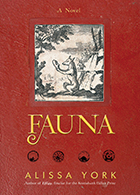
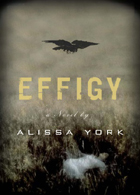
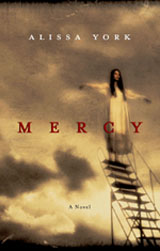


Re. Effigy:
"Novel is a small masterpiece." Whole article, .pdf, 52 KB.
– National Post, July 28, 2007
"The writing (in Effigy) is artful, sinuous and fresh, with each page giving up surprising metaphors and phrasings. It's the kind of story one reads compulsively, all the while wanting to delay the moment of the final sentence, even though it's clear, early on, that she'll nail that too."
– Books in Canada, October 2007
"York's prose is vivid and sensual." Rating: NNNN (4 out of 4). Whole article.
– NOW Magazine, November 1-7, 2007
"Alissa York, who garnered critical praise for her first novel Mercy in 2003, has written a book that, like the taxidermist at its centre, succeeds brilliantly." Whole article, .pdf, 76 KB.
– Edmonton Journal, May 13, 2007
"York's writing is graphic and impressionistic, sharp-edged and sensual. Though both style and landscape at times bring to mind Annie Dillard and Cormac McCarthy, York's voice is very much her own." Whole article, .pdf, 156 KB.
– Quill and Quire, April, 2007
"York displays a gift for the creation of suspense, not through plot but through character. . . . Juggling multiple narrators with a rare ease, York weaves a complex array of themes." Whole article, .pdf, 116 KB.
– Calgary Herald, April 15, 2007
"Exquisite detail in Alissa York's historical novel Effigy ensures that readers are transported to 19th-century Utah, specifically the ranch of a polygamous Mormon family, where seething tensions do not remain below the surface. . . . York skillfully shows the power of belief, especially when it is connected to need." Whole article, .pdf, 2.0 MB.
– Globe and Mail, April 14, 2007
"An impressive new novel by Toronto author Alissa York." Whole article, .pdf, 156 KB.
– Edmonton Journal, April 12, 2007
"Editor's Choice. . . . Recommended."
– Vancouver Sun, April 14, 2007
"Een fascinerende roman (a fascinating novel)." Whole article, Dutch, .pdf, 244 KB.
– Oene Kummer, SPITS, Amsterdam, February, 2007
"Donker en onheilspellend is Vreemde ogen zeker te noemen." Whole article, Dutch, .pdf, 160 KB.
– Donata van der Rassel, 8Weekly, Amsterdam, February, 2007
Re. Mercy:
". . . an exquisitely rendered novel that is almost painful to read."
– Quill and Quire, December, 2002
"... le livre splendide d'Alissa York. Avec une maîtrise et une ampleur très surprenantes pour un premier roman, ces Amours défendues [Mercy] se tiennent donc à la frontière entre l'ombre et la lumière, dans un espace perçu comme une zone de combat.." Whole article, French, .pdf, 36 KB.
– Le Monde, November, 2007
"Mercy is . . . compulsively readable, a triumph of York's storytelling prowess. It would be an impressive novel from an established author; from a debut novelist, it is a small miracle, graceful and unflinching, violent and beautiful, heartfelt and haunting."
– Vancouver Sun, February 1, 2003
"The first novel by Winnipeg writer Alissa York is stunning in its emotive power and emotional resonance. York’s prose is taut and finely honed; her themes and the characters and settings that propel them are far-reaching and profound."
– The Hamilton Spectator, January 18, 2003
"York is emotionally unflinching and her writing is sharp-edged and intense. She can depict both beauty and rot with equal felicity."
– The Globe and Mail, February 15, 2003
"Winnipeg writer Alissa York is perched on the edge of the literary big time with the launch of her debut novel."
– Winnipeg Free Press, January 19, 2003
"Alissa York is a writer to watch."
– Toronto Star, February 9, 2003
"In Mercy, Winnipeg author Alissa York makes a solid debut as a novelist and substantiates the accolades and awards she has attracted for her short stories."
– Winnipeg Free Press, January 26, 2003
Vancouver Sun, February 1, 2003
By Robert Wiersema
THE QUALITY OF MERCY: Alissa York’s first novel is a compulsively readable triumph of storytelling
Winnipeg writer Alissa York has been, for the past several years, one of Canada's most promising young writers. Her 1999 short story collection Any Given Power (which included "The Back of the Bear's Mouth," winner of the Journey Prize, and "Stitches," winner of the Bronwen Wallace Award) was an overlooked gem, a powerful, exciting collection beloved by critics (and by those readers fortunate enough to discover it), which nonetheless escaped widespread public attention. With Mercy, her debut novel, York is likely to receive the attention and the readership she so richly deserves.
When August Day, a young priest fresh from the seminary, is assigned to St. Mary Immaculate in Mercy, Man., in the spring of 1948, he is expecting to assist the aging parish priest, Father Rock. Before his arrival, however, Father Rock dies, leaving young Father Day with a parish of his own. His first duty, the day after his arrival, is the wedding of the town butcher Thomas Rose to Mathilda, the radiant teenaged niece of the church's cleaning woman.
Father Day and Mathilda find themselves immediately and violently attracted to one another, although both try to deny it to themselves. Mathilda takes over the cleaning of the church from her aunt, and their passion grows in their respective isolations until it explodes in a scene so fleeting it might not have even happened, save for the child Mathilda is soon carrying.
That child, a girl, becomes the still centre around which, it becomes clear, all of the other events revolve. Fifty-five years later, when Reverend Carl Mann arrives in Mercy with a plan to develop the bogs and wilderness outside of town, it is the daughter of Mathilda and Father Day who guides him through his dark night of the soul, who speaks to him in the voice of the wilderness, of nature itself.
Mercy is neither a straightforward nor a simple novel. It defies both basic summary and every expectation a reader may bring to it, although it is neither gimmicky nor self-conscious. Rather, the events unfold with the often startling inevitability of human action and failing; everything that occurs is based in the vivid and realistically drawn characters and their interactions. Every action, from a spontaneous exposure in a confessional to the innocent release of Father Rock's stray dogs, has both a motive and an effect, repercussions that echo through the story. The outcome of the narrative strands cannot be predicted, yet the conclusion feels fitting, rather than arbitrary. York is comfortable with mystery, with allowing events to stand on their own without explanation, with bringing events to their conclusion without a sense of forced closure.
She leaves us feeling that we could drive into Mercy tomorrow and find her characters populating its streets, still reckoning, in some way or another, with the legacy of Mathilda and Father Day. Mercy is a novel of haunting contrasts and juxtapositions. The growing passion between Mathilda and Father Day, for example, is juxtaposed against scenes of Rose going about his work, clinical and precise, the heating blood of romance, tinged with poetry and spirituality, contrasted with the spilled blood of the abattoir, the brute physicality of death.
Steeped in both Christianity and more pagan ideologies, in both the town and the bog, the novel's imagery is startlingly original, often surprising, yet always appropriate. A glass house in the depths of the bog, a band of feral dogs, a body perfectly preserved in the acid waters of the bog, a human femur picked clean of flesh - Mercy is an impressionistic novel, building from tiny, finely wrought details to a complex system of references and resonances, images and events gaining import and weight by the reader's immersion in it.
Mercy is also compulsively readable, a triumph of York's storytelling prowess. It would be an impressive novel from an established author; from a debut novelist, it is a small miracle, graceful and unflinching, violent and beautiful, heartfelt and haunting.
Mercy will likely draw comparisons to two other debut novels of recent years. While it has much in common with Ann-Marie MacDonald's Fall on Your Knees and Gail Anderson-Dargatz' The Cure For Death By Lightning - a rural setting, a backdrop of both religion and violence, a vivid and compelling cast of characters - Mercy is by far the strongest of the three novels, riskier, more challenging and, ultimately, more rewarding.
Excerpt from: The Hamilton Spectator, January 18, 2003
By Gary Curtis
A DEBUT THAT’S PURE MAGIC: Emotive power and emotional resonance propel a first novel
The first novel by Winnipeg writer Alissa York is stunning in its emotive power and emotional resonance. York’s prose is taut and finely honed; her themes and the characters and settings that propel them are far-reaching and profound. It’s sensual, full of yearning and longing for the heat of love. . . . There’s been a recent gnashing of teeth in Canadian literary circles, decrying the lack of urban, urbane fiction. Works, such as Mercy, that focus on rural lives are no less sophisticated, no less compelling, no less inclusive. York has wrought a wonderful, thrilling, complex, immensely satisfying tale.
Quill and Quire, December 2002
By Jeffrey Canton
MERCY
In her debut novel, Alissa York drops her readers into small-town Mercy, Manitoba, in the summer of 1948. Like her award-winning short fiction, Mercy is told in a series of spare vignettes that are rattled off like rosary prayers, providing us with a quick entry into the interconnected stories about butcher Thomas Rose on the eve of his marriage, and his sloe-eyed and slender bride-to-be, Mathilda Nickels.
Also introduced are Mathilda’s maiden aunt Vera; town drunk and visionary Castor Wylie living in a shack on the bog at the edge of town; and young Father August Day, the new parish priest and son of a small-town whore, who can’t quite take leave of the sins of the flesh. At the heart of this first section of the novel are the brief and tempestuous skeins of an adulterous love affair that gradually bind Mathilda and Father Day into a painful passion play that ultimately destroys them both.
York then thrusts us 53 years forward as Carl Mann, preacher and philanderer, sweeps into Mercy like his predecessor, causing almost as much havoc. Mann loses his way in the bog where he is attacked by an owl, then rescued by Bog Mary, Castor’s daughter. Meanwhile, his latest flame, Mercy’s Mayor Lavinia Wylie, is restlessly waiting for yet another night of passion with the lusty priest.
Past and present circle round in a series of cartwheels that York stage-manages to create an exquisitely rendered novel that is almost painful to read. Chapter headings highlight the various narrative threads, past and present. These headings include snippets of prayers in English and Latin, the names of the Virgin Mary, butchering terminology, the animals and birds who inhabit the boglands, and, most fittingly in a novel where the sins of the flesh play such a striking part, the parts of the human body.
Globe and Mail, February 6, 2003
By Carol Toller
BLESSED BY THE MUSE: Short-story writer Alissa York's first novel, Mercy, was conceived with the visitation of two characters: a tortured priest and a woman named Mary
TORONTO -- Alissa York didn't set out to write a novel about faith and its corrupting power. She didn't intend to tap into the current controversy over sexual abuse in the Roman Catholic Church.
Instead, she says, her story began innocently enough -- with a character named Mary, a reclusive wild woman who lives in a bog.
"Mary presented herself to me," says the Winnipeg-based writer, "and I had the sense she was part of something large. She had a size to her . . ."
So York let Mary hang around in her head, where she asserted an almost physical presence "like a buzzing that wouldn't go away."
Then came another visitation, this time from a tortured character called August Day, "who insisted upon being a Catholic priest." The lives of the two characters became intertwined (to say anything more would amount to a spoiler), and before long, York -- who until recently was known for her short stories -- found herself juggling an ambitious debut novel. Entitled Mercy, after the fictitious Manitoba town in which the story is set, the newly released book features dual narratives. One takes place between 1948 and 1949, the other unfolds during a single night in June, 2003.
The link between the two? Men of faith tortured by lust.
There's something a little incongruous about a smart, thirtysomething writer with the gamine looks of Audrey Tautou -- better known to the world as Amélie -- writing a novel that draws heavily on religious symbolism and a sense of Gothic fatalism. Mercy conjures a world that's more William Faulkner than Jonathan Franzen, and fans of writers like David Foster Wallace and Jonathan Safran Foer may find the novel too rich for a postmodern diet.
"We live in an age of irony, and a lot of the stuff [in my novel] doesn't go down with some people," York admits, "but I believe in all of it. I believe that people can learn to live right."
At the same time, the book may invite a little righteous indignation, inhabited as it is by clergymen who can't quite keep it in their pants. Mercy has been bringing Catholics "out of the woodwork," says York, who describes herself as "a spiritual non-joiner." (Her mother is a lapsed Catholic who had her baptized -- though never confirmed -- "just in case," she says.)
"The emotional reaction it provokes has been amazing. It's visceral.
"Some people say, how can you be writing about this at a time like this? But that's part of the job of the writer -- to tell the truth about [issues like sexual abuse in the church]. We talk about this stuff now -- God help us if we didn't."
Besides, she says, Father Day and his contemporary Protestant counterpart, Rev. Carl Mann, aren't the devil incarnate. They're flawed human beings, which makes them attractive to York.
"This may sound trite," she says, "but most people really are beautiful. Carl is the least sympathetic character in the book, but I still love him.
"If you're really honest, almost everything reveals its inner beauty. And that's what I try to be."
For all its New Testament iconography (the story includes a crucifixion with a twist and a sort of inverted Assumption of Mary), York's characters are imbued with Old Testament values -- they pray to a wrathful god. But the closing scene of Mercy hints at the possibility of redemption by suggesting that at least one of these wayward men may change his ways. Even the frailest human soul can undergo a sort of emotional evolution, York seems to be saying, through a steady accretion of goodness, the results as dense and layered as a black spruce bog.
"We have this horror of what's going on inside here," York says, leaning forward and pointing to her heart. "But in fact, it's miraculous."
York got her start in writing late one night in 1992, when a short story popped into her head and started, well, buzzing.
"It was 1 or 2 in the morning," York says, "and this story just appeared, and I said to my husband, 'I have this story -- it's really intense.' "
She wanted to wait until morning to write it down, but her husband, Clive Holden, a poet and filmmaker who knows a little something himself about the creative process, told her not to ignore it.
"He said, 'Get up and write it -- you can't treat that sort of thing lightly.' "
So she did, and that night, she decided she could be a writer.
She didn't keep her first, effusive writing effort, which she now describes as a learning story ("it had something to do with a young woman's rage . . . yikes!"), but the results encouraged her enough to continue. She published her first collection, Any Given Power, in 1999, to enthusiastic reviews. One of the stories included in it, The Back of the Bear's Mouth, won the prestigious Journey Prize for short fiction. (Film rights to it and two other connected stories have been optioned by Winnipeg-based Buffalo Gal Pictures.)
Reviewers of the collection commented on her ability to portray the complexities of small-town life without condescension.
"I guess I'm drawn to small-town settings," she says, "because the less sophisticated people are, the more their true selves are plain to see.
"It's not that there aren't pretensions in a small town, but they may be less convincing. And I like working on a small stage -- the relationships are more intense."
York knows about life in a small community -- she was born in Athabasca, Alta., and since then has lived in Victoria, Vancouver, Saskatoon, Montreal, Toronto and Whitehorse. Much of the travelling she's done with Holden, who she says shares her sense of wanderlust. "We both suffer from it, and neither of us seems to keep the other in check."
It was wanderlust that took them to Whitehorse, where she dabbled in acting, and started contemplating the differences between drama and literature -- and the different satisfactions each might offer.
"I was starting to get ideas for stories," she says, "and I couldn't really see myself fitting into that idea of the actor's life. It went against my grain to be told what to do. And also, you need money to do anything in theatre.
"As a writer, you can sit down with a pen or a computer and do what you like. I liked the idea of the simplicity of it."
Winnipeg Free Press, January 19, 2003
By Morley Walker
NO SMALL MERCY:Winnipeg writer Alissa York is perched on the edge of literary big time with the launch of her debut novel
As she enters the literary fray with her debut novel, Mercy, Winnipeg writer Alissa York seems like a book publicist's dream come true. She brings to the table a few awards, including the 1999 Journey Prize, the $10,000 national honour for her story The Back of the Bear's Mouth, published in the local quarterly Prairie Fire.
Still a few weeks shy of 33, she is personable and articulate. A onetime actress, she handles live appearances with flair. She has been known to read stories by Flannery O'Connor, one of her favourite authors, with southern accents intact. Rumour has it, she can even do a mean Pekinese impersonation.
Tall and slender, with her raven hair set against an ivory complexion, she is also strikingly pretty.
"There is a tendency to buy books for superficial reasons, like a writer's zany lifestyle," York says over a cup of tea in the funky Wolseley home she shares with her husband of nine years, poet and filmmaker Clive Holden.
"In the end, though, it's about whether people find worth in the writing. I want a lifetime of it -- book after book after book."
Mercy is an ambitious undertaking, incorporating big themes of love and death and melding two stories separated by 50 years in the fictional Manitoba town that gives the book its title.
About a priest and the young wife of a butcher and the implications of their actions, the novel overflows with Catholic imagery, surprising from a writer who claims to be "second-generation lapsed" on her mother's side.
Just released by the country's biggest publisher, Random House Canada, to a pre-publication rave in the trade journal Quill & Quire ("an exquisitely rendered novel that is almost painful to read"), Mercy launches York into Winnipeg's literary A-list, a small group that includes David Bergen, Jake MacDonald and Miriam Toews.
"She has talent, skill, eloquence and a way with an image," says Random House publisher Anne Collins, who also edits Carol Shields and Douglas Coupland.
"I was totally impressed with the intelligence she brings to teasing out the narrative."
When she made the Journey Prize short list, the mag's editor, Andris Taskans, says her knee-jerk response was, "I want to win."
"That's when we realized she had the moxie to go all the way, to be a real Canadian literary superstar."
York comes by her moxie honestly. Her Australian-born parents emigrated from Sydney to Athabasca, Alta., an hour north of Edmonton, with their toddler son and their unborn daughter.
"Can you imagine doing that?" marvels York, who pronounces her first name Ah-lee-sa.
"They must have had a sense of adventure."
Seven years later, the family moved to Victoria, where York graduated from high school. She spent a year in Toronto living with girlfriends, then moved to Montreal to study English at McGill University.
Back in Victoria in 1989, still only 19, she met Holden. An artist 10 years her senior who survived as a bus driver, he came into the deli where she was a waitress.
"It was the luckiest day of my life that we met," she says. "We both want to be true to our dreams."
Over the next four years, they lived in Toronto, Whitehorse, Montreal, Victoria and Vancouver. By this time, York had started writing stories. She published her first in 1995.
They moved to Winnipeg in 1997, though they knew almost nobody here. They chose our city methodically: It was halfway between the population centres of Toronto and Montreal and their families in Victoria.
Hanging out at the now-defunct Heaven Art & Book Cafe, they found their social and professional niche. Holden established Cyclops Press, which mixes writing, digital technology, music and poetry. He works at home in a room off the kitchen. Last year, he released the innovative spoken word CD Trains of Winnipeg.
York writes upstairs, often wearing headphones to block out the noise and doing her first drafts in longhand.
"Winnipeg is the perfect place to be an artist," says York, who will launch Mercy 7:30 p.m. Thursday at McNally Robinson Grant Park. "The city is affordable and the arts community is active and supportive."
They pal around with cutting-edge filmmakers, artists, writers and musicians. York's first story collection, 1999's Any Given Power, was published by Arbeiter Ring, the leftie co-operative press fronted by John Sampson, vocalist and songwriter with indie rock band the Weakerthans.
"Alissa is the person I phone when I'm having a creative crisis," says Sampson's partner, Christine Fellows, a singer-songwriter who has created a buzz with her recent CD The Last One Standing, "She has incredible insight into the creative process, from the point where you procrastinate to when you actually get the work done."
With a Jan. 28 launch set for Calgary's McNally Robinson, followed by a Jan. 30 promotional trip to Toronto, York has started research on a new novel, this one set in 19th-century Utah.
She has penned a couple of essays for the publication of the artist-run centre Aceartinc. She wants to improve her skills at non-fiction.
Knowing this, Holden gave her a collection of Susan Sontag essays for Christmas.
"They're wonderful," York says. "I can feel my brain expanding as I read them."
Toronto Star, February 9, 2003
By Judy Stoffman
LOOK WHAT’S COMING OUT OF WINNIPEG: Manitoba capital a literary hotbed - Isolation stokes creative juices
Alissa York is a writer to watch. A former actress who has also worked as a waitress in a sushi restaurant in Victoria and at Sophie's Cosmic Café in Vancouver, she writes prose that reviewers have called energetic, muscular and exciting.
For the past three years, living cheaply in Winnipeg with her filmmaker-husband Clive Holden, she has made a living solely from her writing.
Religion feeds her gothic imagination.
"Behind it lies the great human questions," says the 32-year-old writer on a trip to Toronto to promote her first novel Mercy, just published by Random House Canada, a tightly plotted, somewhat overheated tale of religious fervour, suppressed passions, shame, suicide, pregnancy and death in a small Manitoba town. She has black hair, pale skin and a willowy figure that give her a pronounced Celtic beauty.
"Catholicism is a rich system of symbols. My mother Ann is a recovering or lapsed Catholic and we children were baptized; I think she was hedging her bets. My maternal grandfather was very devout and I had spent a lot of time with him."
As part of her research, she went to Easter mass and took communion to refresh her childhood memories of the rituals. "It was touching and moving and also horrifying."
In 1999, she won the Journey Prize for her short story "The Back of the Bear's Mouth," a retelling of an Australian creation myth set in the backwoods of Canada. Later that year a small Winnipeg press called Arbeiter Ring published her story collection Any Given Power, which won the Mary Scorer Award as the best book by a Manitoba publisher.
York is but one element in Winnipeg's lively literary mix. Perhaps it's the afterglow of Carol Shields' long stay in the city (Shields now lives in Victoria); perhaps the legacy of such icons of an earlier Winnipeg as Adele Wiseman and Margaret Laurence, but the Manitoba capital is at the moment home to some of the country's most talented authors.
Winnipegger Martha Brooks won a Governor-General's Award last year for her young adult fiction True Confessions Of A Heartless Girl. David Bergen, who teaches at a Winnipeg high school, was a Governor-General's Award nominee for The Case Of Lena S. Jake MacDonald writes bestselling non-fiction such as his recent Houseboat Chronicles: Notes From A Life In Shield Country and his fellow Winnipegger Margaret Sweatman took home the Rogers fiction prize last year for When Alice Lay Down With Peter, her third novel.
Says Holly McNally, owner of McNally Robinson, the city's leading bookstore: "Winnipeg has always been a tiny bit isolated. This is our curse and our fortune. We make our own. Our theatre audience is the most stable and devoted in the country. Likewise we support our indigenous authors.
"Local author events are well attended. In fact our event space is usually bursting at the seams. Local authors top our bestseller list week after week. Carol Shields had a tremendous impact on the writing community here. She was generous with her time and mentored people."
"The city is both stimulating and supportive," says York, who moved there with her husband five years ago. For the local launch of her book late last month, 150 people showed up at McNally Robinson.
"There is a burgeoning slam poetry scene, too. With both of us being in the arts, neither of us is pulling in big dollars so it's somewhere where we can afford more living space. A lot of artists live there because it's inexpensive. We bought a house for ... I won't tell you how little."
York was born in the small town of Athabasca in northern Alberta (her model for the geography of the fictional town of Mercy). Her Australian parents had settled there shortly before her birth when her father was hired to teach outdoor education.
"The imprint of Athabasca on me is very strong," she says. She studied for only one year at McGill, then briefly took creative writing at the University of Victoria with poet Lorna Crozier. She wrote her first story at 21, though it was not until four years later that literary magazines began to publish her work.
She likes to read the Southern Gothic writers like William Faulkner and Flannery O'Connor, and their influence is evident in the eccentric loners who populate Mercy: The sexually tormented priest August Day, son of the town slut in Mercy; red-haired Mathilda, raised by her desiccated aunt, who enters into a loveless marriage; Thomas, the town butcher, helplessly in love with a wife who cannot return his love; Mary, the bog woman, wise to nature's ways — York brings them alive on the page by knowing how to dramatize rather than describe.
"The first character to show up was Mary, the middle aged hermit, who lived in a bog," she recalls. "And then her parents kind of came forward. I started to see that part of the story would take place in 1948-49 and the second part in the present."
She then began the long process of research to help her characters "develop dimension."
This reader found her detailed knowledge of how animals are slaughtered particularly unsettling, contributing to the sense of menace in the early part of the story. "All that came out of a book I found," she says. "There was something about the character of Thomas that couldn't be realized without graphic representation of his work."
York has an unusual working method. She writes down what happens to each of her characters, from beginning to end, prints it out in very small type, and cuts up the separate narratives into segments. "I laid it all out on the floor and rearranged it. That's how the main body of the work came about."
Her next novel is already brewing and it, too, will have a religious theme.
"It's a story about Mormons in 19th-century Utah. That's a story line that caught fire for me. I got interested in polygamy and the research took me back to those times."
The Montreal Mirror, February 20-26, 2003
By Juliet Waters
SLAUGHTERHOUSE FINE: Twisted love and a haunted butcher in Alissa York’s Mercy
One weird trend this year is women’s fiction that features butchers. First there was Louise Erdrich’s The Master Butchers Singing Club, and now Alissa York’s much heralded first novel, Mercy, which opens with the slaughter of a cow.
In town recently for a reading at Concordia, I decided to ask York about her interest in this subject. Though she did live in Montreal briefly during the ’90s, she now lives in Winnipeg. We met in the food court of Central Station, just before her train left. As food courts go, it’s one of the better ones, complete with a faux library cafeteria and a Première Moisson, but obviously there’s nothing like Rose’s Fine Meat. This is a butcher shop in the fictional town of Mercy, Manitoba, where the owner, Thomas Rose, also has a killing room. Here, town people can bring their own livestock to be slaughtered and then returned to them in paper parcels.
Notwithstanding her jet-black hair and dramatic features, York actually seems less goth in person than she appears in publicity shots. She explained how she did her research.
"I read books. I’m actually quite squeamish, but somehow when I’m writing about it I’m okay. I never cook with meat, sometimes I eat it. I thought maybe I’d have to go into a butcher shop to research. But I was lucky enough to find a couple of books, and one in particular that had just the right tone to it, and the right illustrations… It was from the right era too, the 1950s. And it had these brutal little subtitles that were almost always quite poetic, kind of like ‘beef, a good bleed.’"
Lest one assume Thomas is a nasty character, he’s actually one of the few truly sympathetic, almost normal characters in Mercy. Though she didn’t set out to create a kindly butcher, it was actually the research York did for an autistic character in the novel that inspired her.
"I had a sense when I started out that he wasn’t purely brutal, but at one point I read a book by Temple Grandin. She’s this really high-functioning autistic, who is a savant at architecture, and her area of expertise is designing animal facilities, including slaughterhouses. She designs it all in her head without any plans, and part of what she does is make these facilities kinder. There’s this thing that happens in slaughterhouses where people become dehumanized, and then they become cruel. But in the places she designs there’s a moment for each animal, and each animal is killed with consciousness. So this whole aspect of Thomas came out in that way."
Sadly, this gentle quality of Thomas has few rewards for Mathilda, the young orphan he marries falls in love with the Catholic priest who performs their marriage. The spectre of Thomas’s brutal occupation is always there to hint that he could use his skills for vengeful justice. But that’s as far as I’ll go in revealing the plot. Mercy is not the kind of novel that would be fair to summarize.
I will say, however, if there are two kinds of women’s fiction readers in the world, the Emily Bronte fans and the Charlotte Bronte fans, Mercy is solidly in the first camp. This is the fiction of dark haunted landscapes (in this case a black spruce bog) and twisted unfulfilled love. It may feel somewhat oppressive for those readers who don’t mind a crazy wife in the attic but ultimately prefer to see intelligent love conquer all.
But it all falls down to a matter of sensibility. "I’m drawn to intense people," says York. "I prefer the sublime landscape to the perfectly tended garden. I prefer bright colours to beige. And I’m drawn to dramatization over philosophizing. I think that’s just my personality. These are the ideas that come to me, these are the characters that come to me… so I do a lot of following that stuff before I even have an idea of what the hell I’m doing."
Hour, February 20, 2003
By Melora Koepke
SPARED PROSE: Winnipeg writer shows sympathy for her gothic small-town devils
The quality of Winnipeg writer Alissa York's debut novel Mercy is, to evoke Shakespeare, not strained. Though there's nothing of the Bard's "gentle rain that droppeth from heaven" in the scalpel-sharpness of York's prose, it is precisely the unstrained quality of her writing that makes this a most uncommon book for a Canadian writer of her generation.
Mercy is not the kind of book one expects from young Canadian writers these days - set in an imagined rural Manitoba outpost, it casts the passions of a small town in a quietly gothic, gruesome magic-realism. The book's first section is concerned with a heightened love-triangle (a love quadrangle?) between Mathilda, a young orphan, her husband, the town butcher, and her confounded parish priest. Love and death are inextricably linked in a metaphoric double bind of butchery and Catholic passion. In the second part, a womanizing pastor lurches out into the wilderness to find the woman, "Bog Mary," whose 53 years living in the peat have something to teach him about his own life.
York, who lives in Winnipeg but was born in Athabasca, Alberta, to Australian immigrants, conjures the wilderness mostly in her imagination. "I'm not what you'd call an outdoorsy kind of person - I mostly only inhabit urban spaces now - but for the first five years of my life, the formative years, I lived in a small town in the bush," she says on the phone. "So [the rural] has made an indelible imprint on me, you could say. Thus far, the lion's share of my work is concerned with those small towns, and the rural spaces that people inhabit in between the urban and the wilderness."
York has a rarely seen compassion in her vision of what makes a story. Her characters are generally fairly repulsive to each other, but are clearly availed of a specific, articulated worldview. "I think [my characters' voices] come from my having to write them truthfully," says York. "To do this, I really have to be inside them, and when that happens, I can't help but empathize with them. Once I start writing from their point of view, it becomes very hard to judge them. A big part of my job is to bring my characters to life, so that I'm not hovering above them and marching them around like toy soldiers. I try to always give enough backstory to try to explain people, to give them dimensions, so it's easier to see them as human beings. Just like in real life, when you meet someone who seems to be a monster, they usually aren't."
There is a certain monstrous quality to most every person in Mercy. The stunning gentleness of her characters is contrasted on every page with their selfishness and, frequently, their insanity. Just like you and me.
What enriches these antiquated gothic fetishes is the depth and precision of York's unflinching research. Suffice it to say that after a stay in Mercy, our daydreams are adorned with an all-too-precise knowledge of what it feels like to saw open the skull of a calf, and of the goings-on within a confessional.
Then there is the perverse fascination with the land. Throughout Mercy, the giant black spruce bog that lies just outside of town colonizes our waking life, the mossy dark of it beckoning us to look closer, rather than to flinch away from what city life now carefully seals away.
Any Given Power (2000):
"Some events in life–loves, losses, injuries, dark discoveries–enter us by force and linger on as symbols that soothe or plague us in ways we barely understand. York has considered these mysteries and turned them into prose that quietly sings. The best of these stories support the note-by-note song with brilliant structure, hitting body and spirit together."
–The Globe and Mail, November 6, 1999
" . . . [there are] strong echoes of American short story master Raymond Carver in [York’s] work."
–The National Post, October 21, 1999
"[York’s] prose is energetic, muscular and exciting . . . [she writes about] pain, cruelty, passion and redemption set against a beautifully observed and delicately realized natural world."
–The Canadian Forum, July/August, 2000
"The best surprise in years. Vivid, stunningly original short stories that stole my breath away."
–Yvette Nolan, www.canadianwriters.ca, 2001 (The Canadian Writers’ Coalition website)
"The touchstone of truth in a fictional world is surprise. When the least expected things seem inevitable and uncontrived, the reader has shared the most generous of all seductions. Alissa York cares fiercely for the integrity of her characters and never intrudes herself upon them, or us. These are truly original stories, charged with the luminous detail that makes us see life afresh."
–Seán Virgo
"[York’s] prose is often not merely delicious but chewy, and her keen sense for erotic mystery generates tension to make the very air sweat."
– Style Manitoba, Autumn 2000
"York’s writing is quiet and confident, deftly assuming in her stories the first-person voices of teenage girls, a husband and father, an adolescent boy and a child. Never do these narrators sound unnatural or untrue . . . We are likely to read more good things from her."
–The Winnipeg Free Press, December 5, 1999
"York’s beautifully drawn characters inhabit a world that is by turns luminous, menacing, mythic, and very real . . . Her stories are original and compelling, but it is the strength of her characters and the beauty of her language that are York’s greatest accomplishments . . . Alissa York is a revelation–I wait impatiently for her upcoming novel."
–The Manitoban, December 1, 1999
"I don’t read a lot of short story collections, but Alissa York’s first book, Any Given Power, has convinced me I should . . . each character is as richly textured as any novelist’s because York finds the most telling and intimate details . . ."
–Victoria Monday Magazine, December 23, 1999
"Like good coffee, the stories in Any Given Power have percolated slowly, drawing out richness and flavour, whetting the appetite for that first taste. And like that coffee, Alissa York’s stories yield a strong, powerful brew that may well keep you up at night."
–Victoria Times Colonist, December, 1999